
Impact of Teagasc research publications
Emma Boughton, Teagasc Library and Information Services Officer
Teagasc uses two main approaches to identify the impact of its research: science excellence and societal impact. Science excellence focuses on peer-reviewed publications and their indicators of quality, while societal impact focuses on understanding the pathways through which such science is put into use and the changes it helps to bring about in society.
Peer-reviewed publications
Measuring the impact of research is a key activity for Teagasc. One method used is to track and monitor the number of articles in scientific journals authored by Teagasc researchers. Another strategy involves tracking how often these articles are cited by other journal articles. Teagasc uses Elsevier’s abstract and citation database, Scopus, and its accompanying research analysis and strategic insights tool, SciVal, to benchmark its research performance.
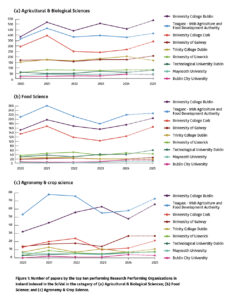
Teagasc compares the performance of Teagasc articles (at least one Teagasc affiliated author) annually to that of other relevant Research Performing Organisations for publications in a rolling six-year period. Publication and citation patterns vary considerably across subject areas. Therefore, comparisons within subject categories are the most meaningful when using publication counts or citation-based metrics. To place our performance in a national context, we can compare Teagasc’s performance with that of Irish universities, within three relevant subject categories: (a) the broad category of Agricultural & Biological Sciences; and two narrower categories, (b) Food Science, and (c) Agronomy & Crop Science. Citation counts are merely a snapshot in time, as citations are accumulating constantly. The metrics shown are from SciVal as of 22 April 2026.
How Teagasc compares
Comparing Teagasc with the top eight ranked universities in Ireland, in the SciVal broad category of Agricultural & Biological Sciences, Teagasc published the second highest number of publications (414) in 2025 (Figure 1a). For the narrower category of Food Science (Figure 1b), Teagasc had the highest overall number of publications (231); and, for Agronomy & Crop Science (Figure 1c), Teagasc had the highest overall number of publications (73) in 2025.
The citation counts for the three ‘All Science Journal Classification’ subject areas for 2025 were: Agricultural & Biological Sciences (ranked second at 1,325 citations); Food Science (ranked second at 943 citations); and Agronomy & Crop Science (ranked second at 169 citations).
Geographic collaboration is crucial in scientific publishing because it combines diverse perspectives, specialised expertise and pooled resources to tackle complex, global challenges.
The strong international and national reputation of Teagasc research is demonstrated by the fact that for 2020 to 2025, 60.8% of the Teagasc peer-reviewed articles indexed by SciVal listed international collaborators, with 34.8% listing national collaborators. Of course, all bibliometric analysis must be placed in context, and the impact of our research must be evaluated in various other ways to give the full picture.
Impacts from technology transfer and knowledge exchange in 2025
Compiled by Siobhán Jordan, Head of Technology Transfer and Commercialisation, Teagasc
In 2025, Teagasc continued to strengthen its role as a national innovation partner, translating publicly funded research into tangible economic, environmental and societal impact. Through sustained and increasingly strategic engagement with industry, Teagasc supported the development and adoption of technologies, products and services that enhance competitiveness, sustainability and resilience across the agri-food sector.
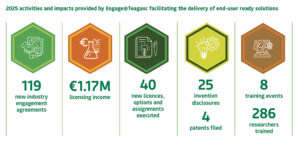
Engage@Teagasc, the organisation’s Technology Transfer Office, played a vital role in supporting researchers and enabling collaboration and commercialisation. In 2025, 25 invention disclosures were captured, including a strong pipeline of digital technologies, alongside four new patent applications, reflecting the breadth of commercially relevant research emerging across Teagasc programmes.

Licensing remained the primary route to impact, with 40 licences, options and assignments executed, contributing to a growing portfolio of 97 active agreements. Over €1.17 million in licensing income was generated in 2025, demonstrating both the scale and maturity of Teagasc’s commercialisation activity and its contribution to national knowledge transfer performance. Initiatives such as the Teagasc START Fund and the FAST-IP collaboration with UCD continue to strengthen the pipeline of future commercial opportunities and training for entrepreneurs.
Industry engagement continued at scale, with €5.53 million in research expenditure linked to industry collaboration and 19 new collaborative research agreements signed in 2025, primarily through the second phase of the VistaMilk Research Ireland Research Centre. Teagasc’s national research infrastructure and pilot-scale facilities further enabled companies to develop, validate, and scale innovations towards market.
Together, these activities highlight how Teagasc is building a robust innovation pipeline, supporting the translation of research into real-world solutions that benefit farmers, food producers, and the wider economy.
Potato fields in summer
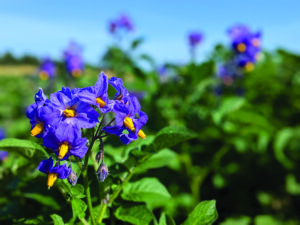
The potato breeding programme at Oak Park has been in existence since 1962. Of the 60 varieties released since then, over 25 are still in commercial production today, and fourteen varieties have been released since 2002. The ability to identify traits of interest, such as disease resistance traits, at an early stage is key to the breeding process. By using markers associated with the genes governing these traits by testing small amounts of plant material, we can identify resistant material at an early stage in the breeding process.
Contributor: Katie Hetherington
Project: Potato breeding